
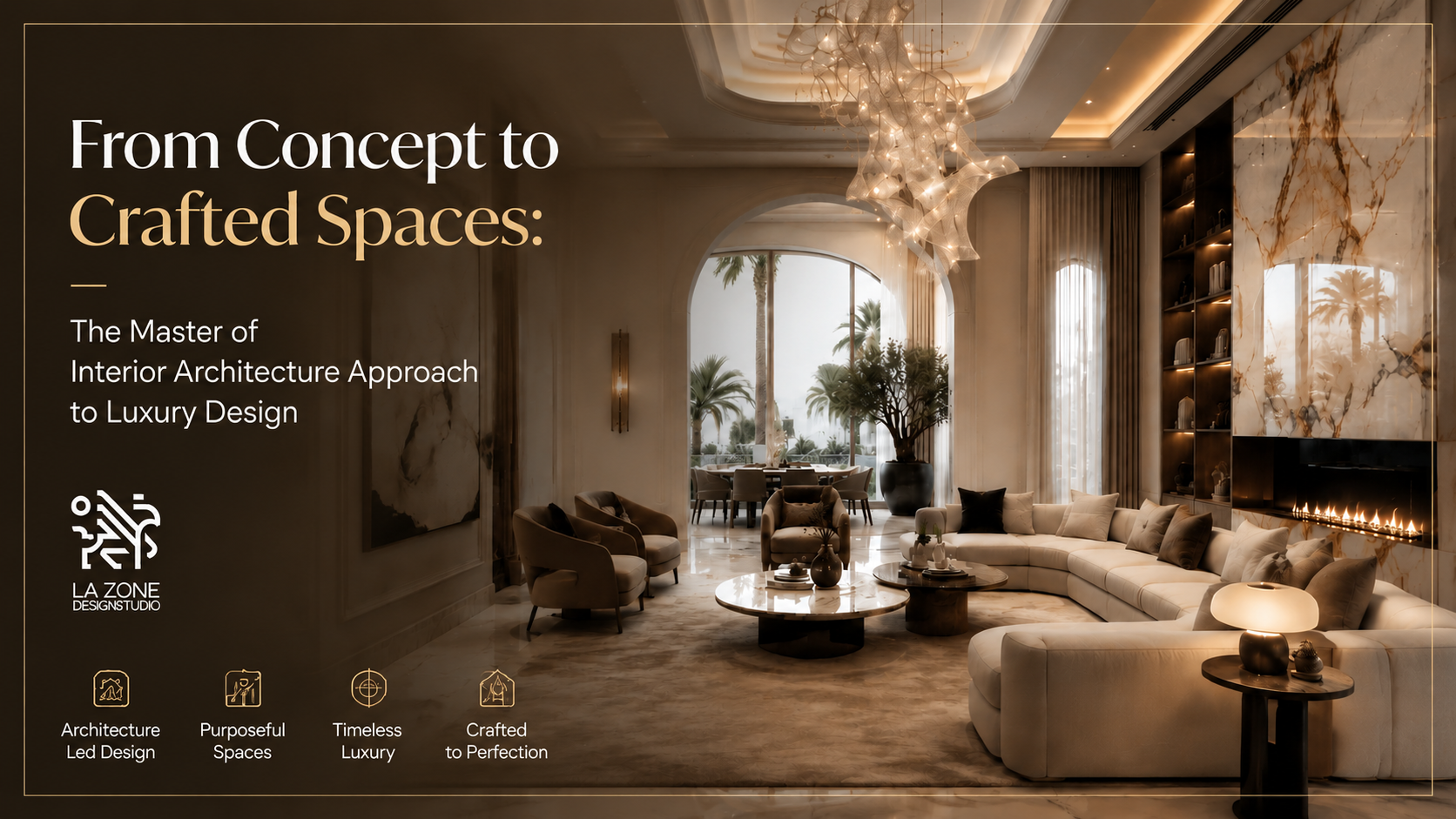
Introduction
Luxury interiors are no longer defined simply by expensive furniture, dramatic finishes, or oversized decorative elements. Today, exceptional interiors are created through a deeper understanding of architecture, human movement, materials, lighting, proportions, and lifestyle. This is where the concept of a master of interior architecture becomes particularly important.
Interior architecture brings together the disciplines of architecture and interior design to create spaces that are visually impressive while remaining purposeful and comfortable. In a city such as Dubai, where contemporary architecture, luxury residences, hospitality destinations, and premium commercial spaces continue to evolve, this integrated approach can make a significant difference.
A sophisticated Design Studio Dubai approach focuses on more than selecting colours and furnishings. It considers how a space functions from the moment a person enters it, how natural light moves through the interiors, how materials interact with one another, and how every architectural detail contributes to the overall experience.
For clients seeking distinctive luxury environments, LA ZONE Design Studio represents an approach where design is developed as a complete spatial experience. From conceptual planning to material selection and final detailing, every decision can be coordinated to create interiors with character, balance, and long-term appeal.
What Does “Master of Interior Architecture” Really Mean?
The phrase ‘Master of Interior Architecture’ represents a level of expertise that goes beyond conventional interior decoration.
Interior architecture deals with the relationship between the built structure and the people who use it. It considers elements such as the following:
- Spatial planning
- Circulation and movement
- Architectural proportions
- Lighting
- Materiality
- Ceiling design
- Wall treatments
- Joinery
- Furniture integration
- Acoustics
- Functional zoning
- Visual hierarchy
Instead of treating interiors as a layer added after construction, interior architecture considers the interior environment as an integral part of the building.
This philosophy is especially relevant to luxury projects. A beautifully designed villa, penthouse, hotel, or commercial space needs more than attractive finishes. It needs a carefully considered relationship between architecture, interiors, functionality, and identity.
A master of the interior architecture approach, therefore, focuses on creating spaces that feel cohesive from the structural elements to the smallest details.
Why Interior Architecture Matters in Dubai
Dubai has developed into an international destination for architecture and design. Its skyline is recognised globally, while its residential, hospitality, retail, and commercial interiors increasingly reflect sophisticated international design influences.
This environment has also raised expectations among property owners and developers.
Clients are looking for interiors that offer:
- Distinctive visual identity
- High-quality craftsmanship
- Intelligent space planning
- Bespoke detailing
- Contemporary luxury
- Functional comfort
- Timeless appeal
A professional design studio in Dubai must therefore understand that luxury is not achieved through a single design element. It is created through the coordination of multiple layers.
For example, a luxury villa may include marble flooring, custom furniture, decorative lighting, timber wall panels, and statement artwork. But if these elements are not proportioned correctly or if circulation is poorly planned, the interior may still feel uncomfortable.
Interior architecture brings these components together into a unified design language.
Designing Around the Way People Live
One of the strongest characteristics of a master of interior architecture approach is that it begins with people rather than with products.
Before choosing furniture or finishes, designers need to understand how occupants will use the space.
A luxury residence may require clearly differentiated zones for the following:
- Formal entertaining
- Family gatherings
- Private relaxation
- Work
- Dining
- Wellness
- Recreation
- Guest accommodation
The relationship between these zones influences the entire design.
For example, a formal living room may need a visual connection with the entrance while remaining separated from private family spaces. A kitchen may need to connect naturally with dining and outdoor entertaining areas. Bedrooms may require greater privacy and controlled lighting.
These decisions are fundamentally architectural.
This is why the work of a design studio in Dubai can extend far beyond decoration. The objective is to create a spatial experience that responds naturally to the lifestyle of its occupants.
The Role of Spatial Planning in Luxury Interiors
Spatial planning is one of the foundations of interior architecture.
A room may have beautiful finishes, but if its furniture arrangement restricts movement, its functionality is compromised. Similarly, a large villa can feel surprisingly small when spaces are divided without considering visual continuity.
A master of interior architecture approach studies the following:
- How people enter the space
- Where they naturally move
- How rooms connect
- Which areas require privacy
- Where views should be emphasised
- How natural light enters
- How furniture interacts with architecture
This creates a more logical spatial hierarchy.
In luxury interiors, transitions between spaces are particularly important. Corridors, staircases, entrance halls, galleries, and transitional zones should not be treated as leftover areas. They can become important parts of the overall architectural narrative.
Creating a Strong Architectural Identity
Every memorable interior needs an identity.
This does not necessarily mean following an extreme design trend. Instead, it means establishing a consistent relationship between architectural elements, materials, colours, textures, lighting, and furnishings.
A master interior architecture approach may begin by defining a design language.
For example, a project could be based on:
- Contemporary minimalism
- Modern luxury
- Warm contemporary design
- Neoclassical elegance
- Sculptural architecture
- Biophilic interiors
- Refined Mediterranean influences
Once the design language has been established, individual decisions can support it.
The result is an interior where the ceiling, walls, floors, furniture, lighting, and architectural features appear to belong to the same story.
Materials as Architectural Elements
Materials are among the most powerful tools available to an interior architect.
Stone, timber, metal, glass, fabric, plaster, and decorative finishes can dramatically influence how a space feels.
However, luxury does not necessarily mean using the most expensive material available.
The more important consideration is how materials are combined.
A carefully selected stone can become a focal point. Timber can introduce warmth into a contemporary environment. Metal details can add precision. Textured plaster can create depth without overwhelming the space.
A sophisticated Design Studio Dubai approach considers material selection alongside the following:
- Lighting
- Scale
- Texture
- Colour
- Maintenance
- Durability
- Architectural context
This ensures that materials contribute to the design rather than simply decorate it.
Lighting: The Invisible Architecture
Lighting is often described as the jewellery of an interior, but its role is much deeper.
Good lighting can influence the perceived scale, mood, texture, and hierarchy of a space.
A master of interior architecture approach typically considers several layers of illumination.
Ambient Lighting
This provides general illumination and establishes the overall atmosphere.
Architectural Lighting
Integrated lighting can emphasise walls, ceilings, staircases, niches, and architectural features.
Decorative Lighting
Pendant lights, chandeliers, table lamps, and sculptural fixtures can act as design elements.
Accent Lighting
Accent lighting can highlight artwork, material textures, furniture, or architectural details.
The goal is not simply to make a room brighter. It is to create depth and visual hierarchy.
Dubai’s strong natural light also makes daylight planning an important component of interior design. Window treatments, reflective surfaces, material colours, and spatial orientation can all influence how daylight behaves inside a property.
Bespoke Detailing and Custom Joinery
Luxury design often becomes memorable through details that cannot simply be purchased from a catalogue.
Custom joinery can integrate storage, entertainment systems, lighting, doors, display units, and architectural features into one cohesive composition.
For example, a wall may incorporate the following:
- Concealed storage
- Decorative panels
- Integrated lighting
- Television systems
- Artwork niches
- Display shelving
Instead of appearing as separate components, everything becomes part of the architecture.
This is another area where the expertise of a master of interior architecture can make a difference. The designer considers the complete wall elevation, proportions, materials, functionality, and technical requirements before developing the final detail.
Luxury Villa Interiors Require an Integrated Approach
Dubai’s luxury villa market demands interiors that respond to large and complex spaces.
A villa can include multiple bedrooms, formal living areas, family lounges, dining spaces, kitchens, entertainment zones, terraces, pools, gardens, wellness areas, and staff facilities.
Without careful planning, these spaces can feel disconnected.
A professional design studio Dubai approach can establish a clear relationship between public and private areas.
For instance:
Public Zone:
Entrance → Formal Living → Dining → Entertainment
Semi-Private Zone:
Family Lounge → Kitchen → Casual Dining
Private Zone:
Bedrooms → Dressing Areas → Private Bathrooms
Wellness Zone:
Gym → Spa → Sauna → Relaxation Area
This zoning strategy creates clarity while allowing the overall residence to feel connected.
Technology and Modern Interior Architecture
Modern luxury interiors increasingly integrate technology into the architectural design.
Smart-home systems can control:
- Lighting
- Temperature
- Curtains
- Security
- Audio
- Entertainment
- Access
- Energy management
The challenge is ensuring that technology does not disrupt the visual character of the interior.
A master of interior architecture approach can incorporate technology discreetly through concealed speakers, integrated controls, automated blinds, hidden screens, and carefully planned electrical systems.
The result is a space that feels sophisticated without appearing overly technical.
Sustainability and Long-Term Design
Luxury and sustainability are no longer opposing concepts.
Clients increasingly want spaces that are durable, efficient, and responsibly designed.
Interior architecture can contribute through:
- Durable material selection
- Efficient lighting
- Natural ventilation strategies
- Responsible sourcing
- Long-lasting furniture
- Adaptive spatial planning
- Reduced material waste
The objective is to design interiors that remain relevant beyond short-lived trends.
A timeless interior can also be more sustainable because it reduces the need for frequent renovation simply to keep up with changing styles.
Choosing the Right Design Studio Dubai
Selecting the right design partner is one of the most important decisions in a luxury project.
When evaluating a design studio in Dubai, clients should consider more than portfolio images.
Look for a studio that demonstrates:
1. Strong Design Philosophy
A good studio should have a clear understanding of how it approaches architecture and interiors.
2. Portfolio Diversity
Review completed residential, hospitality, and commercial projects where relevant.
3. Attention to Detail
Look closely at joinery, lighting, material transitions, ceilings, doors, and architectural details.
4. Understanding of Functionality
Beautiful images are not enough. The spaces should also demonstrate intelligent planning.
5. Project Coordination
Large luxury projects involve architects, contractors, consultants, suppliers, and craftsmen. Strong coordination is essential.
6. Material Expertise
The studio should understand how different materials behave, age, interact, and perform within the local environment.
7. Personalised Design
Your project should feel specific to your lifestyle, property, and aspirations rather than like a copy of another project.
How LA ZONE Design Studio Approaches Interior Architecture
LA ZONE Design Studio’s design philosophy can be understood through the idea that luxury should feel intentional rather than excessive.
An effective interior is built through a sequence of carefully considered decisions—from the overall spatial concept to material palettes, lighting, furniture, and detailing.
The Master of Interior Architecture approach places emphasis on the complete experience.
Rather than viewing each room independently, a project can be developed as a connected journey.
The entrance establishes the first impression. Circulation leads occupants through the residence. Public spaces create opportunities for interaction. Private spaces provide comfort and retreat. Lighting changes the atmosphere throughout the day, while materials create continuity between architectural zones.
This holistic approach allows luxury interiors to feel sophisticated without becoming visually overwhelming.
The Future of Luxury Interior Architecture in Dubai
The future of Dubai’s interiors is likely to become increasingly personalised.
Instead of simply following international trends, clients are looking for environments that express their lifestyles, personalities, cultural influences, and aspirations.
This creates opportunities for designers to explore:
- Bespoke architecture
- Art-integrated interiors
- Wellness-focused spaces
- Smart-home technology
- Sustainable materials
- Flexible living environments
- Indoor-outdoor relationships
- Experiential hospitality design
The role of the master of interior architecture will therefore continue to evolve.
The designer is not simply selecting objects for a room. The role increasingly involves shaping how people experience space.
Conclusion
A truly successful luxury interior is created when architecture, design, functionality, materials, lighting, technology, and human experience work together.
The philosophy behind a master of interior architecture approach provides a framework for achieving this balance. It transforms interiors from collections of decorative elements into carefully designed environments with structure, identity, and purpose.
For clients looking to create sophisticated residences, hospitality environments, or commercial spaces in the UAE, working with an experienced design studio in Dubai can help transform ambitious ideas into cohesive architectural experiences.
LA ZONE Design Studio approaches luxury interiors as complete spatial stories—where every proportion, material, lighting decision, and architectural detail contributes to the final experience.
In modern Dubai, where expectations for luxury continue to rise, the future belongs to interiors that are not merely beautiful but also thoughtful, functional, distinctive, and architecturally meaningful.
FAQ
1. What does a Master of Interior Architecture focus on?
A master of interior architecture focuses on advanced spatial planning, architectural detailing, materials, lighting, functionality, human movement, and the relationship between interior spaces and the building structure.
2. Why is interior architecture important for luxury villas in Dubai?
Interior architecture helps create better spatial flow, functional zoning, integrated lighting, bespoke detailing, and a cohesive relationship between architecture and interiors, making it highly valuable for luxury villa projects.
3. How do I choose a design studio in Dubai for my project?
Review the studio’s portfolio, design philosophy, experience, attention to detail, project management capabilities, material expertise, and ability to develop personalised solutions for your property.
4. Is interior architecture different from interior design?
Yes. Interior design traditionally focuses heavily on finishes, furniture, colours, and decoration, while interior architecture places greater emphasis on spatial planning, architectural elements, circulation, structure-related details, and the relationship between people and space.
5. Can LA ZONE Design Studio handle luxury interior projects?
LA ZONE Design Studio can develop luxury interior concepts around spatial planning, architectural detailing, material palettes, lighting, bespoke elements, and the overall visual and functional experience of a project.