
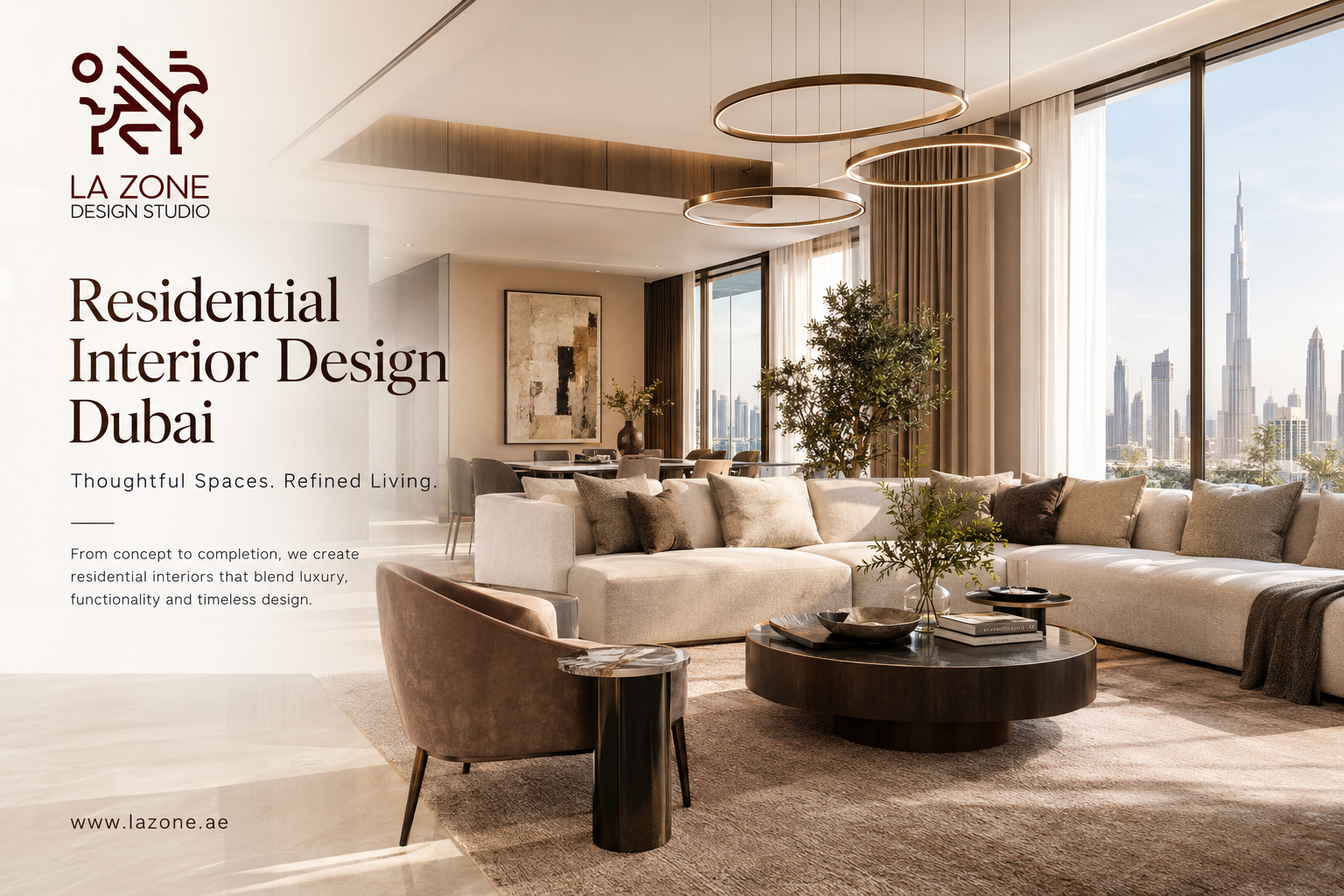
Dubai is a city where architecture, lifestyle, luxury, and innovation come together in remarkable ways. As homes continue to evolve with changing lifestyles, residential interiors are no longer viewed simply as a collection of furniture, finishes, and decorative elements. A thoughtfully designed home needs to respond to the people who live in it, the way they move through their spaces, and the way they entertain, work, relax, and connect with their surroundings. This is where residential interior design in Dubai becomes an important part of creating a home that feels both sophisticated and genuinely livable.
A well-designed residential interior brings together spatial planning, architecture, materials, lighting, furniture, color, texture, technology, and functionality into one cohesive experience. The objective is not simply to make a home look luxurious. It is to create an environment where every element has a reason to exist and where beauty works together with comfort and everyday usability.
At La Zone, residential design is approached as an integrated process. Architecture, interior design, planning, visualization, project management, and execution can be coordinated under one design direction, helping ideas developed during the design stage translate more accurately into the completed environment. La Zone describes its approach as combining creative exploration with technical discipline, with particular attention to proportion, material integrity, execution quality, and long-term usability.
What Is Residential Interior Design?
Residential interior design is the process of planning and developing the interior environment of a home according to its architecture, occupants, lifestyle, functional requirements, and aesthetic direction. It involves much more than selecting furniture or choosing wall colors.
A residential interior designer considers how rooms connect with one another, how people move through the home, how natural light enters different areas, where storage should be positioned, how furniture should be proportioned, and how materials and finishes will work together. The design also considers practical aspects such as lighting, electrical requirements, circulation, acoustics, privacy, comfort, and maintenance.
In Dubai, these considerations become particularly important because residential properties can vary significantly in scale and character. A compact apartment requires a different approach from a large villa, while a contemporary penthouse may demand a different design language from a family residence.
The best residential interiors therefore begin with understanding the home itself and the people who will use it.
Designing Around the Way People Live
Every household has its own rhythm. Some homeowners frequently entertain guests, while others prefer quiet family spaces. Some need dedicated work areas, private lounges, entertainment rooms, children’s spaces, or wellness areas. Others may require extensive storage, smart-home integration, or flexible spaces that can change according to different needs.
A successful residential interior design responds to these requirements before aesthetic decisions are finalized. When planning begins with lifestyle, the final interior can feel more natural because the design is connected to real daily activities.
This approach also helps prevent a common problem in residential design: creating spaces that look impressive in photographs but are difficult to use comfortably.
Why Residential Interior Design Matters in Dubai
Dubai has developed a distinctive residential design culture influenced by international architecture, luxury hospitality, contemporary art, technology, and diverse lifestyles. Homeowners increasingly expect interiors to be refined while still being functional and personal.
Residential interior design in Dubai therefore requires a careful balance. A home can incorporate premium materials and sophisticated detailing without becoming visually overwhelming. It can feel luxurious without sacrificing comfort. It can be contemporary without becoming dependent on short-lived trends.
Good design creates this balance by establishing a clear relationship between every layer of the interior.
Luxury Should Be Experienced, Not Just Seen
Luxury interiors are often associated with marble, dramatic lighting, large furniture, designer pieces, and expensive finishes. While these elements can contribute to an elegant environment, luxury is ultimately more about the quality of the overall experience.
A beautifully planned entrance, comfortable furniture proportions, carefully controlled lighting, quiet bedroom finishes, intelligently designed storage, and seamless movement between spaces can contribute to a stronger sense of luxury than decoration alone.
La Zone’s interior design philosophy places emphasis on precision, refined materiality, and meticulous detailing, while also considering comfort, function, and the everyday experience of the space.
The Importance of Space Planning in Residential Interiors
Space planning is one of the most important stages of residential interior design. Before colors, finishes, furniture, or decorative elements are selected, the layout needs to work.
The placement of walls, doors, furniture, storage, circulation routes, and functional zones determines how the home will feel and perform.
An effective layout allows movement to feel natural. It creates relationships between rooms without making the spaces feel crowded. It also considers sightlines, privacy, natural light, furniture scale, and the relationship between public and private areas.
Creating Better Movement
Movement through a home should feel intuitive. Living areas, dining spaces, kitchens, bedrooms, bathrooms, and service zones need to connect logically.
In larger villas, zoning becomes even more important. Formal living spaces may need separation from family areas, while bedrooms can require additional privacy. Entertainment areas, home offices, wellness spaces, and outdoor connections also need to be integrated without disrupting the overall flow.
This is why planning should happen before decorative decisions. A beautiful finish cannot compensate for an inefficient layout.
Residential Interior Design for Dubai Villas
Dubai villas provide designers with significant opportunities to create distinctive residential environments. Larger floor areas, double-height spaces, landscaped surroundings, terraces, pools, basements, and multiple levels allow interiors to be developed on a much larger scale.
However, additional space also creates additional design challenges.
A large home needs visual continuity. If every room follows a completely different design language, the residence can feel disconnected. Instead, designers can establish a consistent material palette, architectural language, lighting approach, and furniture direction while allowing individual rooms to maintain their own identity.
Living Rooms That Feel Sophisticated and Comfortable
The living room is often one of the most important spaces within a Dubai residence. It may be used for family time, entertaining guests, formal gatherings, or quiet relaxation.
Furniture scale is particularly important in large living rooms. Oversized spaces can easily make standard furniture appear insignificant. A carefully selected combination of sofas, lounge chairs, tables, rugs, lighting, wall treatments, and artwork can help establish a sense of proportion.
The objective is to create a living environment that feels generous without feeling empty.
Bedrooms Designed for Calm
Bedrooms require a different design approach. While living spaces may have stronger visual statements, bedrooms benefit from a calmer atmosphere.
Soft textures, controlled lighting, comfortable furniture, integrated storage, balanced colors, and carefully selected materials can create a more restful environment.
The bedroom should also be considered in relation to privacy, natural light, views, and circulation. In luxury residential interiors, even seemingly small details such as bedside lighting, wardrobe organization, curtain systems, and concealed storage can significantly affect the experience.
The Role of Materials in Residential Interior Design
Materials are central to the character of an interior. Stone, wood, metal, glass, fabric, plaster, textured surfaces, and other finishes each contribute different visual and tactile qualities.
A sophisticated residential interior does not necessarily require many materials. In many cases, a carefully controlled palette can create greater visual cohesion.
The relationship between materials is equally important. A stone surface can feel different depending on the surrounding wood, lighting, metalwork, or textiles. The same material can also create different impressions depending on scale and application.
Material Selection Should Consider Longevity
Residential interiors need to remain functional for years. Materials therefore need to be considered not only for their immediate visual impact but also for durability, maintenance, and relevance over time.
La Zone’s design approach specifically highlights material integrity and long-term usability as important considerations in project development.
This creates an important distinction between simply decorating a home and designing an environment intended to perform well over time.
Lighting as an Architectural Element
Lighting can transform the way an interior is experienced. It influences atmosphere, perception, functionality, and material appearance.
Residential lighting should generally be considered in layers. Ambient lighting provides general illumination, task lighting supports specific activities, and accent lighting can highlight artwork, architectural features, textures, or furniture.
In luxury residences, lighting can also be integrated into architectural details. Concealed lighting, wall washers, recessed fixtures, pendant lights, decorative fixtures, and integrated furniture lighting can all contribute to a more sophisticated environment.
Natural light is equally important. Window placement, curtains, glazing, mirrors, surface finishes, and furniture positioning can influence how daylight moves through the interior.
Furniture and Custom Design
Furniture is one of the elements that gives a residential interior its personality. The right furniture should respond to the scale of the room while supporting comfort and functionality.
In premium residences, custom furniture can provide additional opportunities for personalisation. A bespoke sofa, dining table, bed, console, wardrobe, or storage element can be developed according to specific dimensions and design requirements.
Custom pieces can also help connect different parts of a home. Materials, colours, forms, and detailing can be repeated subtly across furniture and architectural elements, creating a unified design language.
The result is an interior that feels designed as a complete environment rather than assembled from unrelated products.
Creating a Personal Design Language
A home should reflect the people who live there. Trends can provide inspiration, but they should not replace individuality.
Personalisation can appear through artwork, furniture, materials, colour preferences, collections, architectural details, and the way rooms are arranged. The most successful interiors often balance the client’s personal preferences with a clear overall design direction.
This is particularly relevant to residential interior design Dubai because homes often need to respond to diverse cultural backgrounds, lifestyles, and aesthetic preferences.
A strong designer does not simply impose a style. Instead, the design process should translate the client’s requirements into a cohesive spatial experience.
Integrating Technology Into Modern Homes
Technology has become an increasingly important part of contemporary residential design. Smart lighting, climate control, automated curtains, security systems, entertainment systems, and integrated home controls can improve convenience.
However, technology should ideally support the architecture rather than dominate it.
Controls, speakers, screens, and equipment can often be integrated discreetly into the interior. This allows homeowners to benefit from modern functionality while maintaining visual clarity.
For luxury homes, smart technology can become part of a broader lifestyle strategy where comfort, convenience, security, and entertainment are integrated into the design from the beginning.
Designing Around Natural Light and Views
Dubai residences can offer impressive views, particularly in high-rise developments, waterfront properties, and villas with landscaped surroundings.
A thoughtful interior design should respond to these views rather than compete with them. Furniture placement, window treatments, colours, and architectural elements can be planned to maintain important sightlines.
Natural light can also become an important design feature. Instead of blocking daylight with unnecessary partitions or heavy treatments, designers can use layout and material choices to maximise its effect.
The result can be an interior that feels brighter, more open, and more connected to its surroundings.
A Structured Approach to Residential Interior Design
A successful residential project benefits from a clear process. At La Zone, the project journey is structured around discovery, concept and planning, execution and coordination, followed by completion and handover.
Discovery
The process begins by understanding the client’s objectives, preferences, lifestyle, spatial requirements, and expectations. This creates a foundation for the design direction.
Concept and Planning
The concept is then developed through spatial planning, material selections, design decisions, and technical documentation. The aim is to balance aesthetics with practical requirements.
Execution and Coordination
Once the design is approved, coordination becomes essential. Materials, drawings, site progress, quality control, and various project requirements need to remain aligned with the approved design.
Completion and Handover
The final stage involves reviewing the completed environment and ensuring that the finished space reflects the design intent established at the beginning.
This structured approach can help reduce fragmentation between design ideas and their physical execution.
Residential Interior Design for Apartments and Penthouses
Not every residential project in Dubai is a villa. Apartments and penthouses require their own design strategies.
In apartments, efficient space planning becomes especially important. Storage, furniture proportions, circulation, and multifunctional spaces can make a significant difference.
Penthouses, on the other hand, may provide expansive views, terraces, large living spaces, and premium architectural features. Their interiors can be designed to emphasise openness while maintaining warmth and functionality.
In both cases, the design should respond to the architecture rather than forcing a predetermined style onto the property.
The Connection Between Architecture and Interior Design
Interior design becomes more powerful when it is considered alongside architecture.
The relationship between ceiling heights, openings, staircases, wall proportions, materials, lighting, furniture, and circulation can determine how cohesive a residence feels.
La Zone operates as an integrated architecture and design studio, with architecture, interiors, project management, visualization, and fit-out aligned under a coordinated direction.
This integrated perspective can be especially valuable for new-build residential projects, major renovations, and luxury villas where architectural and interior decisions need to work together from the earliest stages.
Designing Homes That Remain Relevant
One of the most important goals of residential interior design is longevity.
Trends will change, but the fundamental requirements of a home remain relatively consistent: comfort, functionality, proportion, quality, privacy, storage, light, and a strong connection to the people who live there.
A timeless residential interior does not have to be traditional. It can be contemporary, minimal, dramatic, warm, or highly expressive. What makes it enduring is the quality of its planning and the clarity of its design decisions.
The Novelle, one of La Zone’s residential projects in Dubai, demonstrates an approach centred around clean architecture, natural light, efficient planning, refined material detailing, comfort, movement, and long-term usability.
Residential Interior Design Dubai by La Zone
Creating a refined home requires more than selecting beautiful finishes. It requires a complete understanding of how architecture, interiors, materials, furniture, lighting, technology, and lifestyle work together.
La Zone approaches residential design with a focus on precision, purpose, refined detailing, and integrated execution. Its portfolio includes residential projects across Dubai, including The Harmony in Dubai South, The Novelle in DIC, and Black Pearl in Pearl Jumeirah.
Black Pearl, for example, was conceived as a highly personal luxury residence with spaces planned for family living, entertainment, work, spirituality, and private leisure. Its design demonstrates how residential interiors can be shaped around the specific lifestyle of the people who will inhabit the home.
The Harmony takes a different direction, focusing on calm tones, soft curves, natural light, refined detailing, and an elevated everyday residential experience.
These different projects demonstrate an important principle: residential interior design does not need to follow one universal formula. Every home can have its own identity while maintaining strong principles of planning, proportion, material quality, comfort, and execution.
Conclusion
Residential interior design Dubai is ultimately about creating homes that feel considered from every perspective. The strongest residential interiors combine beauty with practicality, luxury with comfort, and individuality with architectural clarity.
From the first planning conversation to material selection, lighting design, furniture placement, technical coordination, and final execution, every decision contributes to the finished experience. When these decisions are developed through one cohesive design direction, the result can feel natural, refined, and complete.
For homeowners in Dubai, the goal should not simply be to create a home that looks luxurious today. It should be to create a residence that continues to feel comfortable, personal, functional, and relevant over time.
La Zone brings together architecture and interior design through a structured process focused on precision, integrated execution, material quality, and long-term usability. For residential projects where design and execution need to work together, this approach creates a foundation for spaces that are not only visually refined but also designed around the realities of modern living.
A home is more than its walls, furniture, and finishes. It is an environment shaped around everyday life. Thoughtful residential interior design transforms that environment into a space with identity, purpose, comfort, and lasting character.